米国財団法人 野口医科学研究所

サイトマップ

お問い合わせ

HOME

 
設立趣旨 あゆみ 組織概要 臨床留学プログラム アラムナイ活動及び研修レポート セミナーのご案内 野口ニュース
 

TOP  財団設立20周年記念誌

寄稿
 The Noguchi Medical Research Institute
                                      野口医学研究所 評議員会名誉副会長
                                        トーマスジェファーソン大学 名誉医学部長
                                        Joseph S. Gonnella

”Science and art belong to the whole world and
before them vanish the barriers of nationality”
                       -Goethe


Introduction

Medical education is an international experience. The sharing of medical knowledge is as old as the profession itself. From the earliest recorded history until the present, medical education has been an international endeavor.

What happens to one nation will, in some way, ultimately affect the rest of the world. The problem of hunger is not restricted, for example, to any single nation or group of nations. Viruses spread and attach without regard for national boundaries, as today's global concern for Hepatitis B and C and the autoimmune deficiency syndrome (AIDs) will attest.


Mutual Benefits of International Education

We in the United States have directed our energies to expanding medical knowledge, medical technology, systems of health care administration, and training of international physicians in the hope that these efforts will culminate in a healthier world. Our schools and hospitals have helped educating many foreign physicians. In the recent past, we have witnessed many foreign physicians' complete graduate medical education in the United States and return to their native lands to establish training programs, clinics and hospitals. We know, in general, the benefits derived by developing nations, but rarely have we asked ourselves what we get from our participation in international education. Lest we forget, teaching is a learning experience.

So it is in international education. When a developing nation no longer depends on, but functions actively as an integral part of, the collective world community, the full richness of shared discovery is realized. In a global sense, the goal of international education is mutual exchange of ideas and a sharing of cultures.

Reciprocity in International Sharing

When we speak of international exchange it has largely been one-way. True reciprocity has been lacking. Too often we interpret such exchange to be "technology transfer." Yet, technology is a means and not an end.

In all countries, the selection of medical students, the design of medical curricula, the evaluation of medical students and residents, the assessment of physicians' performance, and the evaluation of health care are issues generating controversy. In the absence of scientific evidence, most debate is based on subjective opinion. To clarify these issues and to document to society the value of our educational programs, data must be collected at many points during the journey through medical education. Those of us who are responsible for educational and health care programs must consider these as experiments. Hypotheses should be stated and tested in different settings or countries.
Collaborative studies are needed. Changes should be introduced only when costs/benefits have been proven or at least considered. The benefits of this approach are:
 ・Faculty and students will learn that the scientific model can be applied in education;
 ・The contribution of the physician will be placed in its proper perspective.
Research on the question of how to select the best medical students should take into consideration many factors. It is insufficient to study only the relationship between admissions predictors and performance in the basic sciences. Although such research meets the needs of faculty, it does not address the larger and more important social concerns. Collegial creativity and hard work are required to conduct longitudinal studies of large groups of students to link pre-medical factors with meaningful postgraduate long-term outcomes.

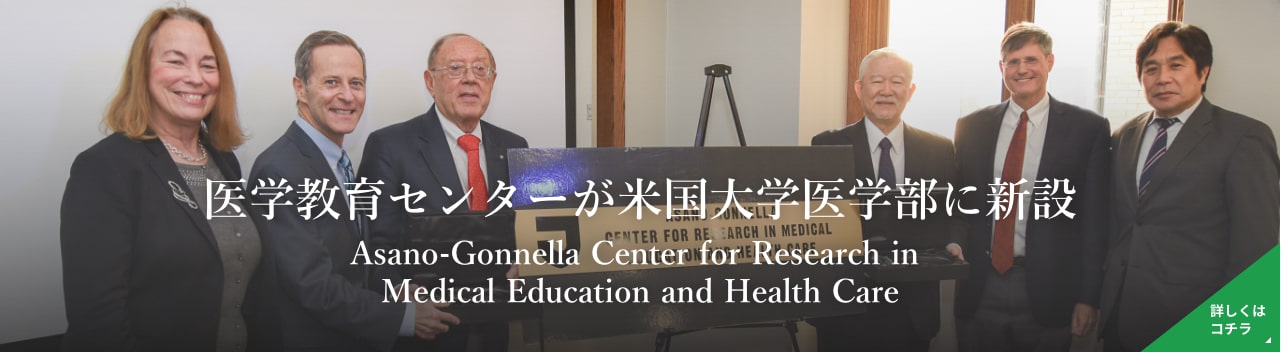
The founders of the Noguchi Institute believed in these concepts and committed their energy and money to foster new programs between Japan and the U.S.A. We need to be
particularly grateful to Drs. Amano and Ojima and Mr. Asano for having led us on this journey.
While we have encountered our share of problems, as all pioneers do, we should be proud of our many accomplishments. A large number of young physicians from both countries have benefited from the exchange programs sponsored by the Noguchi Institute and will disseminate ideas which will foster reforms to improve the educational programs (undergraduate, post-graduate, continuing medical education), and patient care.


References

1. G. Velazquez P. "The Impact on Medical Education in other Countries by Foreign Physicians with Graduate Experience in the United States," in Academic Values in International Medicine (ECFMG 1982, pp. 7-15).

2. Gonnella, J.S. International Exchange: A Shared Approach to the Identification and Solution of Problems in Medicine and Medical Education. Educational Commission for Foreign Medical Graduates 9-12, 1986